
+918042752699

Currently it only shows your basic business info. Start adding relevant business details such as description, images and products or services to gain your customers attention by using Boost 360 android app / iOS App / web portal.
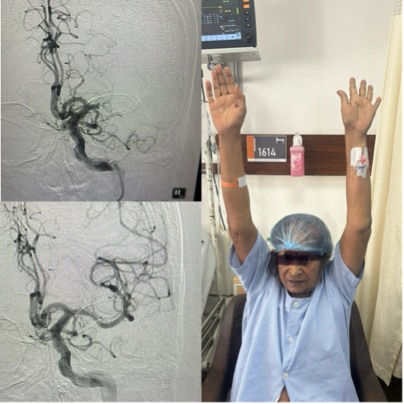
## Mechanical Thrombectomy ### Advanced Stroke Treatment Without Open Surgery Mechanical thrombectomy is a **minimally invasive, life-saving procedure** used to remove blood clots from blocked arteries, most commonly in the brain during an **acute ischemic stroke**. This cutting-edge endovascular treatment has transformed stroke care worldwide and offers patients a significantly improved chance of recovery when performed in time. At leading centers across India and globally, mechanical thrombectomy is now considered the **gold standard treatment** for large vessel occlusion (LVO) strokes. --- ## What Is an Ischemic Stroke? An ischemic stroke occurs when a blood clot blocks an artery supplying blood to the brain. Without oxygen and nutrients, brain cells begin to die within minutes. Rapid restoration of blood flow is critical to prevent permanent disability or death. Mechanical thrombectomy physically removes the clot from inside the blood vessel using specialized devices, restoring circulation and minimizing brain damage. --- ## How Mechanical Thrombectomy Works Mechanical thrombectomy is performed in a specialized Cath Lab or Neurointervention suite by a trained Neuro and Vascular Interventional Radiologist. ### Step-by-Step Procedure: 1. A small puncture is made in the groin (femoral artery) or wrist (radial artery). 2. A thin catheter is guided through blood vessels to the blocked brain artery under X-ray guidance. 3. A stent retriever or aspiration catheter is used to capture and remove the clot. 4. Blood flow is restored immediately in most cases. 5. The puncture site is closed without major stitches. The procedure typically takes **30–90 minutes**, depending on complexity. --- ## Mechanical Thrombectomy vs Clot-Busting Injection (tPA) Traditionally, stroke patients were treated with clot-dissolving medication (thrombolysis). While effective in small vessel strokes, medications alone may not sufficiently treat large clots. Mechanical thrombectomy: * Removes large clots directly * Has higher recanalization success rates * Works even when thrombolysis fails * Can be performed up to 6–24 hours in selected patients Often, both treatments are combined for optimal outcomes. --- ## Who Is Eligible for Mechanical Thrombectomy? Mechanical thrombectomy is recommended for: * Acute ischemic stroke due to large vessel occlusion * Patients within 6 hours of symptom onset (extended window up to 24 hours in selected cases) * Significant neurological deficit * Favorable brain imaging findings Advanced imaging such as CT angiography or MRI helps determine eligibility. --- ## Symptoms of Stroke – Act FAST Early recognition saves lives. Seek emergency medical help immediately if you notice: * Sudden weakness or numbness on one side of the body * Slurred speech or difficulty speaking * Sudden loss of vision * Facial drooping * Severe sudden headache * Loss of balance Time is brain. Every minute counts. --- ## Benefits of Mechanical Thrombectomy * Minimally invasive procedure * No open brain surgery * Faster recovery * Shorter hospital stay * Reduced long-term disability * High success rate in restoring blood flow Clinical trials such as MR CLEAN, DAWN, and DEFUSE 3 have demonstrated significant improvement in functional outcomes with thrombectomy. --- ## Risks and Safety Mechanical thrombectomy is a highly specialized and safe procedure when performed by experienced interventional specialists. However, as with any medical procedure, potential risks include: * Bleeding in the brain * Vessel injury * Re-occlusion * Contrast allergy Careful patient selection and advanced imaging reduce these risks. --- ## Post-Procedure Recovery After thrombectomy: * Patients are monitored in ICU or stroke unit * Blood pressure and neurological status are closely observed * Antiplatelet or anticoagulant therapy may be started * Rehabilitation may be required for speech or motor recovery Many patients show dramatic neurological improvement within hours of successful clot removal. --- ## Why Choose Endovascular Stroke Treatment? Mechanical thrombectomy represents the evolution of stroke care. Compared to conventional management: * Higher independence rates at 90 days * Better quality of life * Lower disability burden Early intervention can mean the difference between lifelong disability and returning to normal life. --- ## Technology Used in Mechanical Thrombectomy Modern devices include: * Stent retrievers * Aspiration catheters * Balloon guide catheters * Advanced imaging guidance systems These devices allow precise clot retrieval with minimal trauma to the vessel. --- ## Importance of a Stroke-Ready Center Successful thrombectomy depends on: * 24/7 stroke team availability * Rapid imaging facilities * Experienced Neuro Interventional Radiologist * Dedicated Cath Lab * Multidisciplinary ICU care Hospitals equipped with comprehensive stroke centers provide the best outcomes. --- ## Mechanical Thrombectomy Beyond Brain Stroke While primarily used in acute stroke, thrombectomy techniques are also used for: * Peripheral arterial thrombosis * Acute limb ischemia * Deep vein thrombosis (DVT) * Pulmonary embolism in selected cases Endovascular clot removal has expanded across multiple vascular specialties. --- ## Frequently Asked Questions ### Is mechanical thrombectomy painful? No. It is performed under local anesthesia with sedation or general anesthesia. ### How soon should treatment begin? As early as possible. Ideally within 6 hours of stroke onset. ### Can elderly patients undergo thrombectomy? Yes, age alone is not a contraindication. Imaging and clinical condition guide decisions. ### What is the success rate? Recanalization rates exceed 80–90% in experienced centers. --- ## The Future of Stroke Treatment Advancements in imaging, device technology, and artificial intelligence are further improving patient selection and outcomes. Mobile stroke units, faster triage systems, and streamlined hospital protocols are reducing treatment delays. Mechanical thrombectomy has revolutionized acute stroke care and continues to evolve. --- ## Take-Home Message * Stroke is a medical emergency * Mechanical thrombectomy can save brain tissue * Early treatment dramatically improves recovery * Advanced endovascular therapy avoids open surgery * Immediate hospital transfer is critical If you or a loved one experiences stroke symptoms, seek emergency care without delay. Timely intervention can restore blood flow, preserve brain function, and save lives.


